4.2 Formation of the Van Allen belt by the solar wind and the rotation of the Earth's weather
[Earth's weather due to the solar wind circulates from West to East]
The Earth has an ionosphere with a dense electron density that reflects
radio waves. The H+ of the solar wind does not reflect radio waves,
but it enters the atmosphere and ionizes with molecules in the sky, so the electrons emitted by the collision ionization form the ionosphere.
At night, electrons are not generated, but recombine with ions, reducing the density of the ionosphere.
The density of hydrogen atoms peaks at around 90 km above ground, and
there is a layer where ozone density peaks at around 25 km above ground.
It is rare for the solar wind H + to reach the ground except in the case of a huge magnetic storm.
However, it gives the atmosphere the momentum that the solar wind's H+ had when it collided with molecules and atoms in the atmosphere.
As a result, S. Karasawa pointed out that it drives the air currents of the Earth's atmosphere in the upper atmosphere.
The atmosphere is also moving with the rotation of the earth, and its
speed is about the same as that of a jet airliner near the equator. Therefore,
the solar wind, which passes through the side of the Earth, accelerates
in the east and slows down in the west, turning the Earth's weather in
a counterclockwise direction. The solar wind that strikes near the equator
in the daytime hemisphere of the Earth has a rotational component due to
the rotation of the Sun, so it drives the trade wind in the clockwise direction
of rotation. As shown in Fig.11, the westerly winds and trade winds orbiting
the Earth are driven by the rotation of the Earth and the H + of the solar wind.
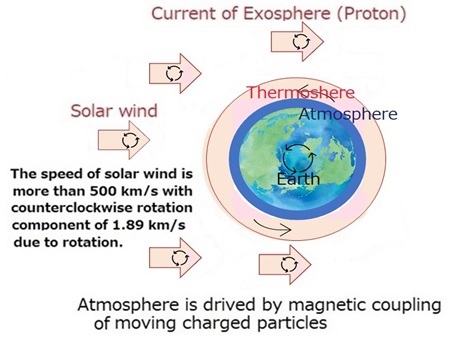
Fig. 10 Rotation of the Earth's weather by the solar wind and the rotation of the Earth
[Formation of the Van Allen Belt]
The Earth is rotating, and of its atmosphere is also rotating. Near the equator, trade winds blow clockwise, while in mid-latitudes, westerlies
blow counterclockwise. This involves charged particles mainly
composed of 1 million tons of protons (H+) from the Sun at speeds of 300km/s
to 900 km/s, and some of these protons collide with Earth‘s atmosphere
of the Earth, driving the rotation of the Earth’s high atmosphere. The
solar wind rotates counterclockwise on the Sun‘s surface at 1.89 km/s on
the surface, so near the equator in the Earth’s day hemisphere,
the atmosphere receiving the solar wind drives a trade wind that rotates
clockwise through a mechanism where the gears mechanism. On
the other hand, in mid-latitudes, the solar wind passing along Earth’s
east side accelerates the atmospheric rotation of counterclockwise Earth‘s
rotation, while on the west side solar wind slow down in the opposite direction
of the Earth’s rotation.
On the Earth's night hemisphere, the counterclockwise solar wind moves around, driving the westerly winds that orbit the Earth's atmosphere counterclockwise. Thus, the group of protons whose solar wind collides with the trade wind
rotates clockwise near the graund while the group of protons collided with
the westerlies orbits counterclockwise in the sky away from the ground.
When charged particle groups run in parallel, there is magnetic coupling
when they move in parallel. charged particle groups run in parallel, there
is magnetic coupling when they move in parallel, However, charged particle
groups run in anti-parallel, there is magnetic repelling. So, a slot regions
arise between the proton groups with the trade wind and the proton group
with the westerlies. As shown in Figure 10, the Van Allen radiation belt
consists of an inner band at altitudes of 2,000–5,000 km and an outer band
at 10,000–20,000 km altitude. There is a slot area without charged particles
between 6,000 km and 13,000 km. In the slot region between the outer belt
and inner belt, the parallel running electrons and protons are recombined and forms the slotting region.
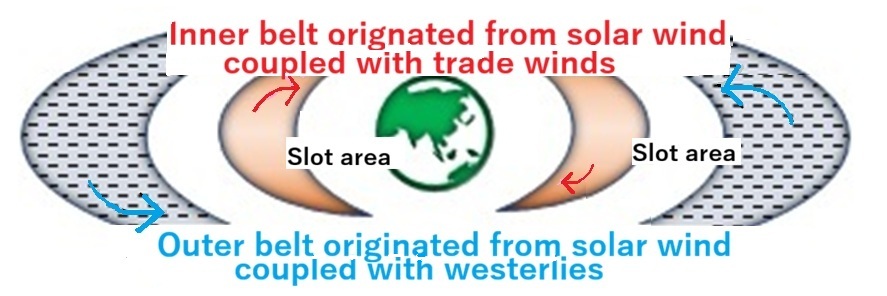
Fig.11 Structure of the Van Allen belt.
index -4.2-